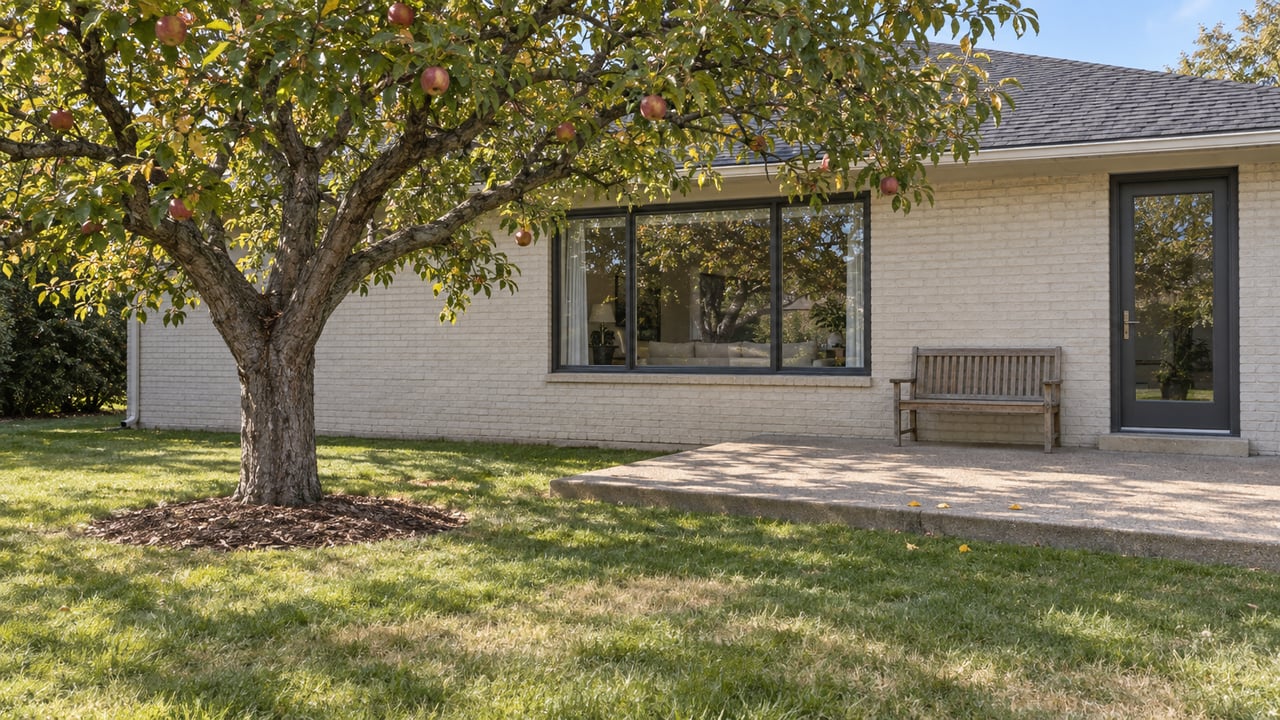
Matt Wilgenbusch went to see a 1927 farmhouse off Tenth Avenue in Lakewood, and he made up his mind in the backyard. "I walked in the backyard, and I'm like, 'This is it, I don't even need to see the house,'" he told CPR News this fall.
His yard had fruit trees, and once he started looking, so did the yards around him. Wilgenbusch is a landscape architect. Since moving in, he has named the apple varieties on his block one by one: Beacon, Cortland, Jonathan, Delicious, Macintosh, Golden Delicious. He sent spring leaf samples to a lab in Washington for DNA testing, and he now grows grafted copies of the heritage trees in his garden.
Those trees tell you something about Lakewood. Many of the apple trees in Lakewood yards are older than the houses around them. This October, they carry a bigger share of the city's apple season than usual.
The Fruit Belt Got Subdivided Around Its Trees
Before the suburbs, this part of rural Jefferson County was known as the "Fruit Belt" of the Front Range. Denver residents rode the Denver and Intermountain Railroad out for a day of apple picking. RTD's W Line to Golden now runs along much of the same route.
The orchards sat where you'd now expect strip centers and side streets. By 1890, Valentine Devinny had opened a you-pick orchard on his ranch near West 6th Avenue and Wadsworth Boulevard, selling the outing to Denver residents. Orchards also clustered along West 13th Avenue between Wadsworth and Kipling Street in the Eiber neighborhood, and along Wadsworth between First and Sixth avenues.
Pests helped end the commercial era first. Codling moth damage started spreading through Front Range orchards in the 1890s. Lakewood and Wheat Ridge were among the cities that lost their orchards that way, and many trees were cut down so the land could be developed. When the land that is now Lakewood was subdivided for houses in the 1930s and 1940s, some homes were built around trees that were already there, and those trees kept growing.
So a mature apple tree in a Lakewood yard may predate the subdivision it stands in. Wilgenbusch sees it on his own street:
"There's actually three different apple trees across the street that are old and kind of heritage. You go further down the street about a block or two, there are three or four or five other varieties as far as I can tell that are just in eyesight."
A Hard Year for the Orchards That Remain
The trees in Lakewood yards matter more in 2026 because Colorado's commercial orchards had a rough season. The Denver Post reported in September that a warm February and March pushed bloom weeks early, and a cold front arrived about two weeks later. Steve Ela of Ela Family Farms in Hotchkiss said temperatures stayed below freezing for 13 hours overnight. "We've had bad years, but I've never had a zero crop," he said.
The freeze also reached the Front Range, whose orchards grow a fairly small share of the state's fruit. Will Perez of Adam's Apple Orchard & Country Store in Ault paused his u-pick operation for now and shifted to country store goods and fall activities.
None of these reports measured how Lakewood's backyard trees did this year. What they do show is that the usual places for a fall apple outing had less fruit to offer. In Lakewood, the next-closest supply is the fruit growing in residents' own yards.
Fifty Years of Cider Days, Still Pressing Apples People Bring From Home
Cider Days ran Oct. 3 and 4 at Heritage Lakewood Belmar Park, 801 S. Yarrow St. This year was its 50th. The Jeffco Transcript described the festival as a celebration of Lakewood's agricultural roots. Visitors could bring their own apples and an empty jug, press them, and take the cider home. The new apple-launching trebuchets were built by Vista Peak Preparatory engineering students, according to park administrator Betsy Bowers. CPR reported that the trebuchets launched discarded, inedible apples.
That bring-your-own setup is the oldest part of the tradition. It is also the part that keeps going after the festival. The city brings out its traditional wooden presses again for a reservation-only Cider Pressing on Saturday, Oct. 17, from 10 a.m. to 4 p.m. at Heritage Lakewood. An earlier session ran on Sept. 18. That day, CPR photographed Kathy Ireland helping two brothers, Caleb and Hudson Tabaka, make cider on an antique press.
Three Places for a Heavy Tree This Month
If your tree is loaded, here is what's available this October.
| Option | How it works | What to confirm first |
|---|---|---|
| Cider Pressing at Heritage Lakewood, Oct. 17 | $25 per reservation buys a 20-minute slot for up to six people. Volunteers help at the press. Press as many apples as you can fit in your slot. | Open slots weren't visible online. Book through the city's event page, and arrive 10 minutes early to sign a waiver. |
| Grow Local Colorado | Volunteers pick and sort the fruit. The best apples go out for eating, and bruised ones become cider and applesauce. | The group has asked owners of heavy trees to get in touch. Ask about this season's dates when you reach out through its website. |
| UpRoot Colorado | Register your tree, and volunteers come to glean it. The harvest is split three ways. | The form asks for your ZIP code and harvest timing. It doesn't promise a Lakewood pickup. |
For the pressing, the city's advice is short: bring lots of apples and a jug or two. Juice jugs and gallon water bottles both work. If you think you have more fruit than one 20-minute slot can handle, the city suggests booking a second slot.
Grow Local Colorado has already picked a Lakewood yard. On Sept. 20, 2025, its volunteers spread tarps under a homeowner's trees, shook the branches, and sorted what fell. That harvest went to Sun Valley Kitchen for the Denver neighborhood's Harvest Fest. Co-founder Barbara Masoner, who has led the fruit effort for six years, said 2024 was the group's biggest year at 11,750 pounds. Its 2025 tally reached 11,867 pounds of fruit picked from local trees, a little more than that record. Masoner started picking fruit in 2019 with only a few volunteers.
UpRoot Colorado organizes volunteer gleaning along the Front Range. One-third of the harvest goes to the tree owner, one-third to the volunteers, and the rest to hunger-relief partners. The group also takes requests for surplus produce, with volunteers delivering the harvest to a local food pantry or food bank.
Before the Apples Go in a Jug
The codling moth that helped end Lakewood's commercial orchards is still the main pest for backyard trees. Colorado State University Extension says its larvae are the familiar "worm" in apples. The pest needs attention in the fall as much as in the summer. CSU Extension recommends a few fall habits:
- Pick off apples with worm damage and get rid of them. Take them off your property, because larvae can keep developing in fruit left on the ground.
- Clear debris away from the base of the tree.
- Remove loose bark, which gives pupae a place to shelter.
Food safety matters too if your apples are headed for a press. The FDA warns that bacteria on fresh produce can end up in untreated cider, and that pasteurization or another treatment is needed to kill harmful bacteria. For home prep, the agency says to wash produce under running water, cut out bruised or damaged spots, and throw away anything rotten. The FDA doesn't have a specific rule for apples picked up off the lawn. Still, its guidance and the codling moth advice both point toward pressing apples picked from the branch and sorting out the rest.
Wilgenbusch is collecting the history behind his neighbors' trees as well as the fruit. He is working with them to document and DNA-test as many trees as he can. Each neighbor gets a printed document describing their tree's variety and its history.
If an old apple tree is part of why you love your Lakewood yard, it's worth knowing its story, both for your own enjoyment and for whoever owns the yard after you. Gregg Francis is always glad to talk about the details that make a Lakewood home feel rooted in its place. Let's Connect.