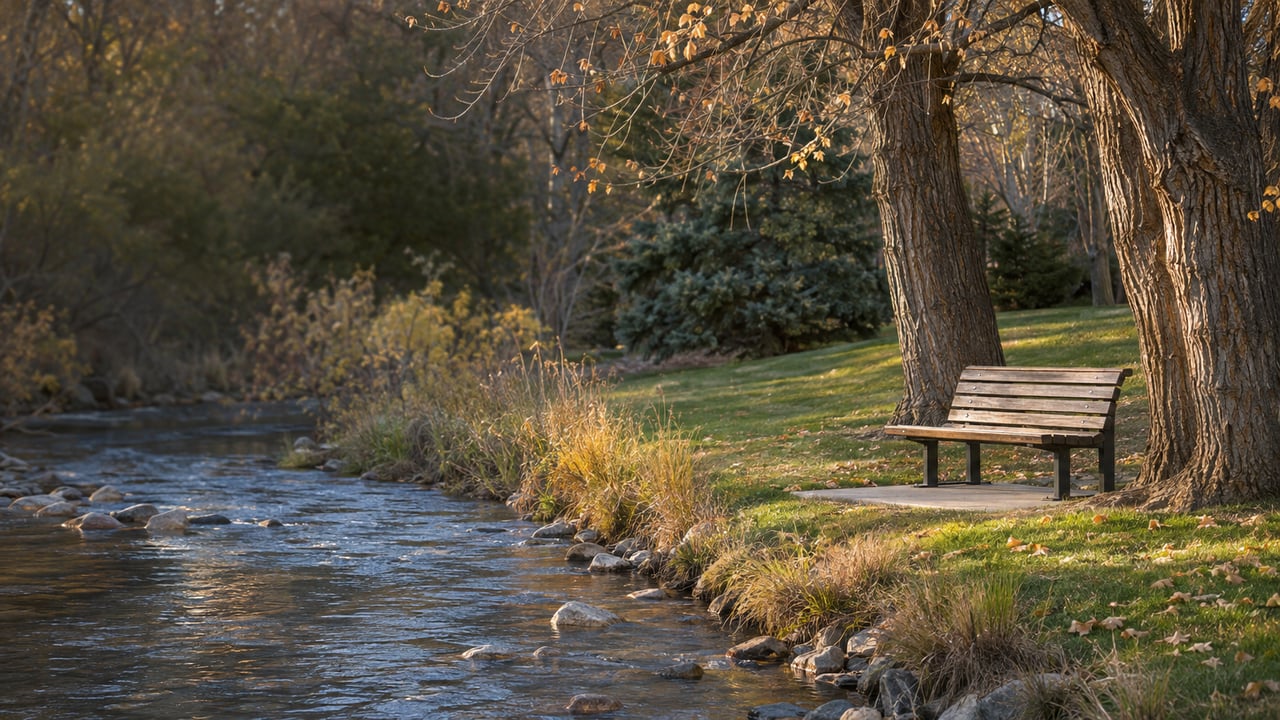
Two city documents describe the same 155 acres of Northeast Park Hill in very different ways. Denver's framework vision for Park Hill Park shows a winding creek, a fieldhouse, a destination playground, sports fields and courts, an aquatic experience, picnic pavilions and a loop trail. The same plan says funding is not confirmed for everything it shows. The other document is the city's October 13, 2026 announcement. It names Michael Van Valkenburgh Associates as lead designer and puts the confirmed funding at $70 million from the 2025 Vibrant Denver Bond.
If you're deciding between South, North and Northeast Park Hill, the gap between those two documents matters. Most of what separates the three neighborhoods on price can be seen from the sidewalk today. The park is the one big variable, and only part of it is settled.
What the price gap already pays for
The three neighborhoods divide along two streets. According to the Denver Public Library's neighborhood history guide, 23rd Avenue separates South Park Hill from North Park Hill, and Martin Luther King Jr. Boulevard separates North from Northeast. On either side of those lines, the houses change.
South Park Hill is the prewar part of Greater Park Hill. A city character analysis prepared for the East Area Plan found that 78% of its buildings went up before 1945 and 82% of its lots are larger than 5,000 square feet. The lots over 10,000 square feet cluster on Montview Boulevard, 17th Avenue Parkway and around Forest Parkway. The same analysis describes Craftsman, Tudor Revival and Spanish Revival houses. It lists Montview, East 17th Avenue, Forest Parkway and Monaco Parkway as historic parkways and flags part of the neighborhood for further study as a possible historic district or conservation overlay.
North of that, the city's Park Hill Neighborhood Plan describes Tudors, bungalows and Denver Squares giving way to postwar ranch homes and low-rise apartments, especially north of 26th Avenue. That plan's census-tract estimates come from the 1980 and 1990 censuses, so they are dated, but they show the contrast clearly. Roughly 70% of homes in the South Park Hill tracts were built before 1940, compared with 36% in North Park Hill and 2% in Northeast Park Hill.
All of this is already in the price. A buyer paying more south of 23rd Avenue is buying a 1920s house on a parkway lot. A buyer north of MLK is buying a postwar house on a different kind of street. Both are paying for things that exist now and will still look the same at closing.
What Northeast Park Hill has gained since fall 2025
Park Hill Park is the one thing in this comparison that has changed recently, and it sits in Northeast Park Hill. Denverite reported that the former golf course opened to the public on October 28, 2025. It has daylight access and walking paths, and the temporary amenities are limited. The city's project page lists the address as 4141 E. 35th Ave.
The October announcement added two things. The first is the designer. MVVA's past work includes Brooklyn Bridge Park and the Obama Presidential Center. The second is the city's stated intent to formally designate the land as a park. The city also said City Council was expected to consider MVVA's design contract later in 2026.
For a buyer looking at homes near 35th Avenue and Colorado Boulevard, the settled part is 155 acres of open space with a named designer and confirmed bond money. It is open today, and anyone can walk it on a weekend before making an offer. A buyer who values that alone and pays for that alone is on solid ground.
The part of the park that is still a bet
The rest of the park is a matter of design and money. The city says it will return to the community with MVVA in 2027 to work out a detailed final plan. Until then, the site stays open space maintained by Denver Parks and Recreation.
The city's request for qualifications lists the scope of work: site preparation, drainage and channel work, lighting and water-play infrastructure, paths and small bridges, shade structures, landscaping and irrigation, outdoor-adventure features and playgrounds. It gives no opening dates for any of them. On cost, the $70 million in bond money is the confirmed figure. In April 2025, Denverite reported a preliminary two-phase capital figure of roughly $200 million.
That means the fieldhouse, the aquatic feature and the full set of sports fields could arrive in phases, take years, or be scaled down. For a buyer, the practical question is how much of a purchase price should go toward amenities whose size and timing depend on a 2027 plan and on funding that so far covers part of the vision. Two buyers can reasonably answer that differently, and each answer should show up in the price they offer.
The blocks around the park are still taking shape
Several smaller projects along the park's edges are moving on their own schedules.
At 40th Avenue and Colorado Boulevard, near the A Line station, the Urban Land Conservancy describes A Line Flats as about 190 affordable homes in the next phase of Park Hill Village West. ULC says the site will sit on the future 303 ArtWay Heritage Trail. The city's Park Hill Action Plan, dated February 2026, lists safer crossings and traffic improvements at 40th and Colorado as priorities, along with bus-stop upgrades and 303 ArtWay wayfinding from the park toward Skyland Park. The same plan proposes finding an operator for a food-growing space at the city-owned detention pond at 38th and Holly, with construction targeted for 2027.
A few blocks south, The Holly shopping center on 33rd Avenue is still in discussion. In September, Denverite reported competing proposals for The Horizon space: a nightclub from tenants, and a boutique grocery and market from a co-owner. The Holly Market is already operating there. Councilmember Shontel Lewis told Denverite it could become a grocery site if its refrigeration were repaired so it could sell fresh produce, meat and dairy. The Denver Urban Renewal Authority has more than $8 million for Northeast Park Hill. Its interim director said grants for the shopping center would wait until ownership and tenancy questions are resolved.
Each of these projects has a real address and an active process. Each is also at the plan or proposal stage. For a buyer comparing a house on Holly Street with one on Montview, that distinction matters more than anything on the park's rendering board.
Why this winter gives buyers time to decide
The broader Denver market is giving buyers room to think. In October 2026, Denver County's single-family median sales price was $704,000, up 0.6% from a year earlier, according to the Colorado Association of Realtors' county report. The average price was $905,276, down 1.4%. Homes took 40 days to sell, 11.1% faster than October 2025. There were 1,619 active listings, 3.5 months of supply, and 385 homes sold, down 19.8% from the year before.
Flat prices and sharply fewer sales usually mean a market where neither side is in a hurry. Inventory was also down 12.4% for the month, so the right house still won't sit for long. Even so, a buyer has time to walk the park, check the parkway lots to the south, and decide how much of any premium near 35th and Colorado goes to protected open space and how much goes to a 2027 plan.
A few questions buyers ask about Park Hill Park
Can I visit the park before I make an offer? Yes. The former golf course has been open since October 28, 2025, with daylight access and walking paths, according to Denverite.
When will the park's final design be public? The city says it will return to the community with MVVA in 2027 to develop a detailed final plan.
Where can I follow the project? The city's Park Hill Park project page and the framework vision site post updates. For a lighter look at the neighborhood, see our September roundup of Park Hill's fall arts festivals or the Park Hill neighborhood guide.
If you're weighing a house near Park Hill Park against a parkway home south of 23rd Avenue, Gregg Francis can help you sort out what you'd be paying for today and what you'd be counting on later. Let's Connect.